The 30-Second Verdict
Who It’s For: Light sleepers who struggle with traditional alarms, shift workers needing flexible sleep schedules, and anyone willing to invest in their sleep routine with a premium bedside device.
The Bottom Line: The Hatch Restore 2 is an excellent sunrise alarm clock with genuinely useful smart features, but the $5/month subscription requirement for most content feels exploitative. If you’re okay with limited free sounds or paying annually, it’s a solid investment. If subscriptions annoy you, look elsewhere.
Rating: 3.8/5 ⭐⭐⭐⭐
Specifications
- Dimensions: 5.7″ diameter × 5.3″ height (compact nightstand footprint)
- Weight: 1.4 lbs
- Connectivity: Wi-Fi (2.4GHz only), Bluetooth
- Display: Dimmable clock face with customizable color options
- Light Output: Adjustable brightness, full RGB spectrum
- Audio: Single speaker, sufficient volume for bedside use
- Power: AC adapter (no battery backup)
- Price Range: $199.99 MSRP (frequent sales around $169)
- Subscription: Hatch+ membership $4.99/month or $49.99/year (optional but heavily encouraged)
- Warranty: 1-year limited warranty
Unboxing & Design
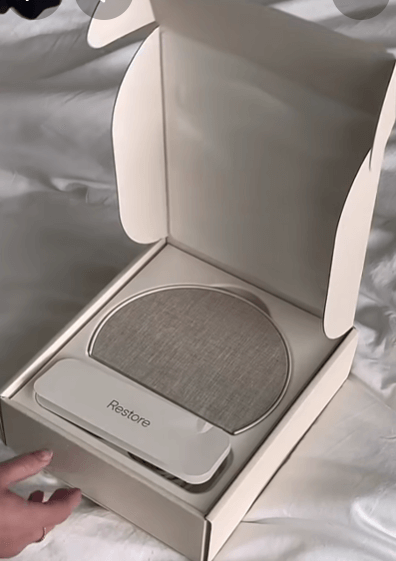
Image Source: YouTube channel @hannahashton.
The Hatch Restore 2 arrives in minimalist packaging that screams “premium wellness product.” Inside, you’ll find the clock itself, a power adapter, and a quick-start guide that’s actually helpful.
The device feels substantial without being bulky. It’s a rounded cylinder wrapped in soft-touch plastic that doesn’t feel cheap, though it’s definitely not the aluminum or glass you’d expect at this price point. The top surface is a large touch-sensitive button surrounded by a rotating ring for adjustments. It’s intuitive once you learn it, but there’s a learning curve.
The Good: The design is genuinely attractive—neutral enough for any bedroom decor. The fabric speaker grille gives it a more sophisticated look than typical alarm clocks. At 5.7 inches wide, it fits comfortably on most nightstands without dominating the space.
The Reality Check: Fingerprints show up easily on the matte finish, and there’s no way to run this thing on batteries. If your power goes out, you’re waking up late.
Setup Process
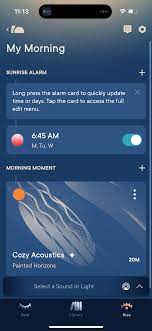
I had the Hatch Restore 2 running in about 8 minutes, which is faster than most smart home devices I’ve tested. Download the app (iOS or Android), create an account, and it walks you through Wi-Fi pairing. The app found my device immediately—no frustrating reconnection attempts.
The app interface is clean and well-organized. You can customize sleep routines, set multiple alarms, and adjust every setting from your phone. This is crucial because the on-device controls are limited to basic functions.
One Annoyance: The app immediately pushes you toward the Hatch+ subscription trial. You can skip it, but they make the free content options feel deliberately limited. More on that later.
Pro Tip: Set up your first sunrise alarm during the day so you can adjust the brightness without waiting until morning. I found the default settings way too bright at first.
Core Features Test
Sunrise Alarm Simulation
This is the headline feature, and it actually works. I programmed the light to gradually brighten over 30 minutes before my alarm time, mimicking a natural sunrise. Starting as a dim orange glow, it transitions through warmer tones until reaching full brightness when your chosen sound begins.
Real-World Test: I’m normally a snooze-button addict who needs three alarms. With the Hatch, I woke up naturally about 5 minutes before the sound started on most mornings. My body responded to the increasing light, making the actual wake-up significantly less jarring. After two weeks, I felt noticeably less groggy in the mornings.
The light is genuinely bright enough—I tested it in a room with blackout curtains, and it still created sufficient illumination. You can adjust the final brightness and the duration (15, 20, 30, or 45 minutes).
The Catch: The most pleasant sunrise color progressions are locked behind the Hatch+ subscription. The free options work fine but feel limited by design.
Wind-Down Routines
This feature combines dimming light, white noise or soundscapes, and optional meditation content to help you fall asleep. You can program a routine like: read with warm light for 30 minutes, then shift to pink noise with gradual dimming over 20 minutes.
I tested this against my usual habit of scrolling my phone until I’m “tired enough.” The difference was measurable. Using the wind-down routine, I fell asleep noticeably faster—probably 15-20 minutes quicker based on my sleep tracker data.
Why It Works: The key is removing decision-making from your bedtime routine. Once programmed, I just tapped the button and let the routine run. The gradual dimming signaled my brain to start shutting down.
Limitation: The free sound options are extremely limited—basically white noise and one or two nature sounds. The good stuff (thunderstorms, ocean waves, guided meditations) requires the subscription.
Smart Speaker Functionality
You can use the Hatch as a white noise machine or reading light throughout the day. The speaker quality is decent for a bedside device—clear enough for podcasts or audiobooks, though you wouldn’t use this for music listening.
I appreciated having physical controls (the rotating ring adjusts volume or brightness depending on mode) rather than fumbling with my phone when half-asleep. The top button can be programmed for quick actions like “start my sleep routine” or “turn everything off.”
The Drawback: There’s no Bluetooth audio streaming unless you have Hatch+. Seriously. A $200 device in 2025 can’t play Spotify without a subscription.
What Could Be Better (Cons)
The Subscription Model Is Aggressive
Let me be clear: the Hatch Restore 2 works without Hatch+, but they’ve deliberately made the free experience feel incomplete. You get maybe 10 sounds total without subscribing, and most of the sleep content, meditations, and better soundscapes are paywalled.
This feels particularly frustrating on a $200 device. I can understand a subscription for a $50 product, but at this price point, more content should be included. After spending $200, being asked for another $60/year feels like getting nickel-and-dimed.
No Battery Backup
If your power goes out or you accidentally unplug it, you’re not waking up on time. There’s no battery backup to maintain your alarm settings. In 2025, this seems like an obvious oversight, especially since competing products like the Philips SmartSleep offers this feature.
I learned this the hard way when my cat knocked the cord loose during the night. No alarm, no clock display, no backup.
The Speaker Could Be Louder
For heavy sleepers, the maximum volume might not be enough. I’m a light sleeper and it wakes me fine, but when I had my partner (who sleeps through smoke alarms) test it, she didn’t wake up at max volume with the sunrise light.
There’s no option to connect external speakers or use your phone as an alarm source within the Hatch ecosystem.
Comparison / Alternatives
If you want to save money: Check out the Philips SmartSleep Wake-Up Light (HF3520) at around $100-120. You lose the app control and smart features, but you get a reliable sunrise alarm with decent sound options and no subscription. It’s less sophisticated but covers the basics well.
If you need more features: Look at the Loftie Clock ($199) which has two alarms (useful for couples), Bluetooth speaker functionality without a subscription, and a backup battery. The sunrise simulation isn’t quite as refined, but the overall package feels more complete.
The Middle Ground: The original Hatch Restore (Gen 1) often goes on sale for $129. It lacks some refinements of the Gen 2 (better speaker, more responsive controls), but offers 90% of the functionality if you’re budget-conscious.
See our full list of alternatives
Final Verdict
The Hatch Restore 2 genuinely improved my sleep quality and morning wake-up experience. The sunrise alarm works as advertised, the build quality is solid, and the app is well-designed. If you struggle with traditional alarms or experience morning grogginess, this device can make a meaningful difference.
Buy it if:
- You’re willing to pay for the Hatch+ subscription (the annual plan makes it more palatable)
- You want customizable sleep routines with minimal friction
- Gentle wake-ups are worth $200 to you
- You have reliable power in your bedroom
Skip it if:
- You’re philosophically opposed to subscription services
- You need very loud alarms (heavy sleepers, look elsewhere)
- You want Bluetooth speaker functionality without extra fees
- You frequently lose power and need battery backup
The Hatch Restore 2 is a very good sunrise alarm clock held back by an aggressive subscription model. At $200 for the hardware plus $50-60/year for worthwhile content, you’re looking at $250-260 in the first year. That’s a significant investment in sleep technology.
Ready to upgrade your mornings? The Hatch Restore 2 is available on Amazon and directly from Hatch. I’d recommend waiting for a sale (they happen quarterly) and committing to the annual Hatch+ subscription if you buy—the monthly cost adds up fast.